Showing posts with label RESEARCH AND PLANNING. Show all posts
Showing posts with label RESEARCH AND PLANNING. Show all posts
Wednesday, 11 March 2015
TEXTUAL ANALYSIS OF BEFORE I GO TO SLEEP
My textural analysis of 'Before I go to sleep' can be seen here.

Sunday, 25 January 2015
Research: Brief history of thriller films
Thriller is a genre of literature, film, and television programming that uses suspense, tension, and excitement as its main elements. Elements of thriller is literature can be dated back as far as ancient times with poems such as the Epic of Gilgamesh and Homer's Odyssey whichuse similar narrative techniques as modern thrillers. Another example is Little Red Riding Hood which is a psycho-stalker story released in 1697.

However, it wasn't until 1926 where one of the first thriller films was created by Alfred Hitchcock which was called 'The Lodger'.He pioneered many techniques in the suspense and psychological thriller genres and was renowned as one of England's best directors.Hitchcock continued to perfect his recognizable brand of suspense-thriller and in 1940 won an Oscar with the film Rebecca which is about the unusual romance between a young woman and an emotionally distant rich widower.
The decades of 1970 and 1980 saw a violent start in the thriller genre, with Frenzy (1972), Hitchcock's first British film in almost two decades, being given an R rating for its vicious and explicit strangulation scene. The decades also saw conspiracy and spy films scattered throughout.
Present day thrillers are now following a theme of the very popular thriller genre – detectives/FBI agents hunting down a serial killers. An example of this is the highly acclaimed Best Picture-winning crime thriller The Silence of the Lambs (1991) where a young FBI agent Jodie Foster in a psychological war against a cannibalistic psychiatrist named Hannibal Lecter.
After learning about how different thriller genres have been effective and how successful they have been, it has given me more of an idea on what genre to base our thriller opening on.


Friday, 16 January 2015
Tuesday, 13 January 2015


Friday, 9 January 2015

Monday, 15 December 2014
One page proposal
One Page Proposal
Working Title:
‘Mind Games’ is our working title, it shows the mental health issues of the
murderer and that his own mind is playing games on him.
Film Genre:
Horror/Thriller
Length:
Estimated 2 Minutes
Target Audience:
· Age: (15+ Year Olds)
· Level of Intellect: Anyone can
watch however it does leave questions which
· Lifestyle: People interested
in thrills, mystery and drama.
· Income: Anyone
· Culture: Appeals to British
(Dialogue = English)
· Bias: Towards males due to only
male actors
· Audience Tone: Average film
goer, inquisitive and interested audience.
Tag Line
“The more you know, the more it takes controls”
‘What If’ Premise
What if you honestly believe that you are innocent even
though you committed the murder of your two friends?
The Story
Synopsis
It said that the mind has complete control. That it can make
you do things, things you might not want to do, bad things, things you thought
you were never capable of. But can you remember these things? As the mind
further consumes it host, how do you escape it...can you escape it?
This is the story of what is supposed to be a calm night in
with three friends; however they are all completely unaware of the horrors that
may befall. As one friend battles against the severe mental problems
threatening to take over, how will he cope with the sudden disappearance and
death of his two friends? Will he start to unravel the truth behind the
killings or will his mind take control? Certain of his innocence he battles
with his unforgiving mind. But who really committed the murders? And will we
ever know...?
Audience Appeal
We understand that our target audience (15+) would be
seeking jump-scares, eerie atmospheres and the occasional sense of mystery.
Baring that in mind, we believe that our final piece will be made up of, and
consist of all 3 of these elements. Once our piece has been fully watched over
we're definite that questions will be left unanswered (in a cliff-hanger type
of manner). Questions such as "how did they become so inhumane?" and
"could they of possibly escaped safely?", making the audience really
think about the plot and what different outcomes could have occurred. We could
imagine young, yet mature actors to embody these roles. Actors such as: Dylan
O'Brien, Thomas Brodie-Sangster and Dexter Darden. These 3 could really capture
the characters innocence yet potential to survive. Leaving that question of
"are they capable?"
Visual Realisation
The look of the film with is very dark, mysterious, gloomy
and the pacing will be fast. Films like this could be the clip called 'lights
out'. Ours will differ because it involves our characters mental health but is
similar as we also aim to show a minimal amount and use the power of suggestion.
Another film in mind would be ‘Shutter island’ that took the same psychological
approach and is a very good approach to that genre so is a good source to refer
to.
Tuesday, 9 December 2014
Filming location.
Location for filming- Stubbing Court, Wingerworth.
I have decided to use this location as it is secluded and isolated which is perfect for a thriller. We as a group have decided to make a supernatural thriller and many films use similar locations as it is easy to create tension whether it be the sound of leaves crunching or trees creeking in the wind. We have the ability to film inside the house as it is in my family and is therefore easy for use to film here.


Inspiration
This a video we found on YouTube and found some of the effects interesting, we are looking to leave it to the imagination of the audience. This video shows how we can make the smallest things seem more than what they actually are. We have taken inspiration from this short clip and the Women in Black.
Wednesday, 3 December 2014
Lighting effects
Lighting effects
We decided to play about with lighting within our group. We tried to use un natural lighting in a dark room to give the character a rather sinister look.
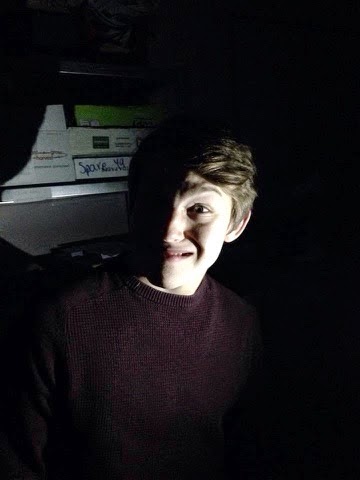

In this photo it shows the character with the un natural light source shining on the right side of his face showing his facial expressions. Whereas on the right side of his face there is no light and therefore creates a mysterious and sinister effect. We may consider using this effect in our thriller. Also in this photo the lighting creates a shadow effect in the background, this was not intentional however is a technique we could look into using.
In this photo we decided to put the un natural light so it was shining under the chin of our character this created the sinister effect we were looking for as it shows all facial expressions but doesn't give off any of the background. This again is a technique we may consider using in our thriller.
Effects of cutaways
Effects of cut aways
we have done this post to show how different techniques can change the ways in which certain scenes can be perceived. one scene could be seen as a different genre depending on what ios to follow, it can create a different emotion.


This use of a cut away above makes the character on the left look crazy and sinister with the character smirking at a dead body. However the cut away below shows a characters reaction to another character making a funny face which makes the scene much more comedic and funny.

Brief ideas for our thriller
We decided to mind map a few brief ideas of what we want our thriller to be like, these brief ideas included:
• Roles in the group - what each individual member will be contributing to the task.
• Location - just a few short ideas on where we want some of our scenes to be shot e.g. woods/beside a pond.
• Plot ideas - we decided to brainstorm a few plot ideas we may incorporate in our thriller. However these notes are brief and may not be followed as written.
• Genre - we decided we want to mix the horror/thriller genre as it gives us a wider audience of film lovers and we believe by adding the horror element we can incorporate more effects.

Sunday, 30 November 2014
Friday, 28 November 2014
Camera shots analysis- Utopia
Camera Shots
The eye line match shot
is used a few times in the scene of Utopia, for instance in the screen shot
below the group have their line of sight matched to the boy, Harry, and this is
effective because it shows the audience what can be seen by the group. This shot
could be used in many ways to show the emotion on the face of the character
before showing what they are reacting to. If this is used to show distress or
fear on the face of the character it gives the audience time in their minds to
think the worst, to try and imagine what it could be. The audience always
imagine something much worse than the film could ever produce. Another example
of this being used in Channel 4’s series Utopia is also attached to the sheet;
the picture of the man looking at the gun. This shot shows Ian, in the
background, looking down at the other man’s trousers in shock before cutting to
an eye line match of a gun down his waist line.
Establishing shot is used
to set the scene, in this particular instance it shows a large majority of the
character and the location before it’s even begun. This shot tells the audience
what is happening and reminds them of what happened previously.
Shallow focus focuses on
the character which is speaking placing importance upon that character. This helps
the audience acknowledge who is speaking and who is superior in that certain
scene. The shallow focus brings someone to the front and boosts their power and
importance. It could also be used to show something behind whilst focusing out
the foreground to maybe show someone being followed this type of shot allows
for the audience to get an understanding of who is the main character in that
scene.
Wednesday, 12 November 2014
Conventions of a thriller
A thriller is a broad genre of literature, television, gaming or film. Often using overlapping sub genres. Thrillers usually include fast paced, lots of action and heroes who must defeat more powerful villains. Thrillers are usually mysteries, but are distinguished by their plot structure. Devices such as red herrings, suspense and cliff hangers are used. Thrillers include a sense of jeopardy and confrontation. Thrillers are usually on a much larger scale and the crimes that must be prevented are often serial or mass murder. Climaxes are used to represent the ending whether explained or not.
Conventions of thrillers:
Character confrontation is between a Protagonist and an Antagonist in thrillers. The Protagonist is usually at the mercy of the Antagonist. The plot and characters are usually binary oppositions or as you may prefer complete opposites.
Types of thrillers:
Spy thrillers- a government agent who must take action against agents of rival governments.
Political thrillers- similarities and features of conspiracy thrillers.
Military thrillers- usually loosely based on fact but may be emphasised or altered for cinematic purposes, making a better story line.
Conspiracy thrillers- usually a small group of people threatening to expose a more powerful opposition, like a government.
Forensic thrillers- forensic scientists who are usually involved in an unsolved crime that threatens their lives.
Psychological thrillers- conflict between characters is mental rather than physical. The protagonist usually has their sanity threatened due to a situation and must overcome this throughout the film to achieve something or beat an enemy.
Horror thrillers – in which conflict between the main characters is mental, emotional and physical.
Supernatural Thriller- in this sub genre otherworldly elements are introduced, some characters may posess a certain power such as psychic abilities.
Religious thriller- where a piece of history/artefact is discovered with so flick between different groups.
Friday, 10 October 2014
Shot practice

Leading lines shot: This shot used to lead the viewer to a certain point in the frame.

Low angled shot: To make the character bigger than their surrounding and show they have power.


The three shots above are all of the same object from different angles. This is to show the object in different ways and the details it has.

Extreme close up: this shot is to establish emotion from characters.

Long shot: used to scenery dominates the character.

Close up: to show enough detail for the viewers to pick up on emotions and scenery.

Establishing shot: This shot is to set the scene for the rest of the film/episode.
Preliminary task
We were set a continuity task involving filming and editing a character opening a door, walking into a room and sitting down in a chair opposite another character, then exchanging a couple of lines of dialogue with each other.
Our film demonstrates the three main things that were asked of us, they were match on action, the switching of scenes to show things happening in parallel. Shot/reverse shot, which is a perspective from over the shoulder of one character to face another showing the point of view and show they have eye contact. The 180-degree rule was also used throughout the whole film, this is to show the two characters without disorientating the audience. Keeping them in the same positions this is to keep continuity too.
Subscribe to:
Posts (Atom)